07 · FINLive✦ AI
Stop guessing where your money goes.
Enter your income and spending across 16 categories. See your actual Needs / Wants / Savings split against your chosen framework. Get an alignment score, identify your biggest overspend, and get an AI brief that tells you exactly what to cut.
50/30/20 · 60/20/20 · 70/20/10 · Custom · 10 currencies
Free · Every tool unlocked · No card
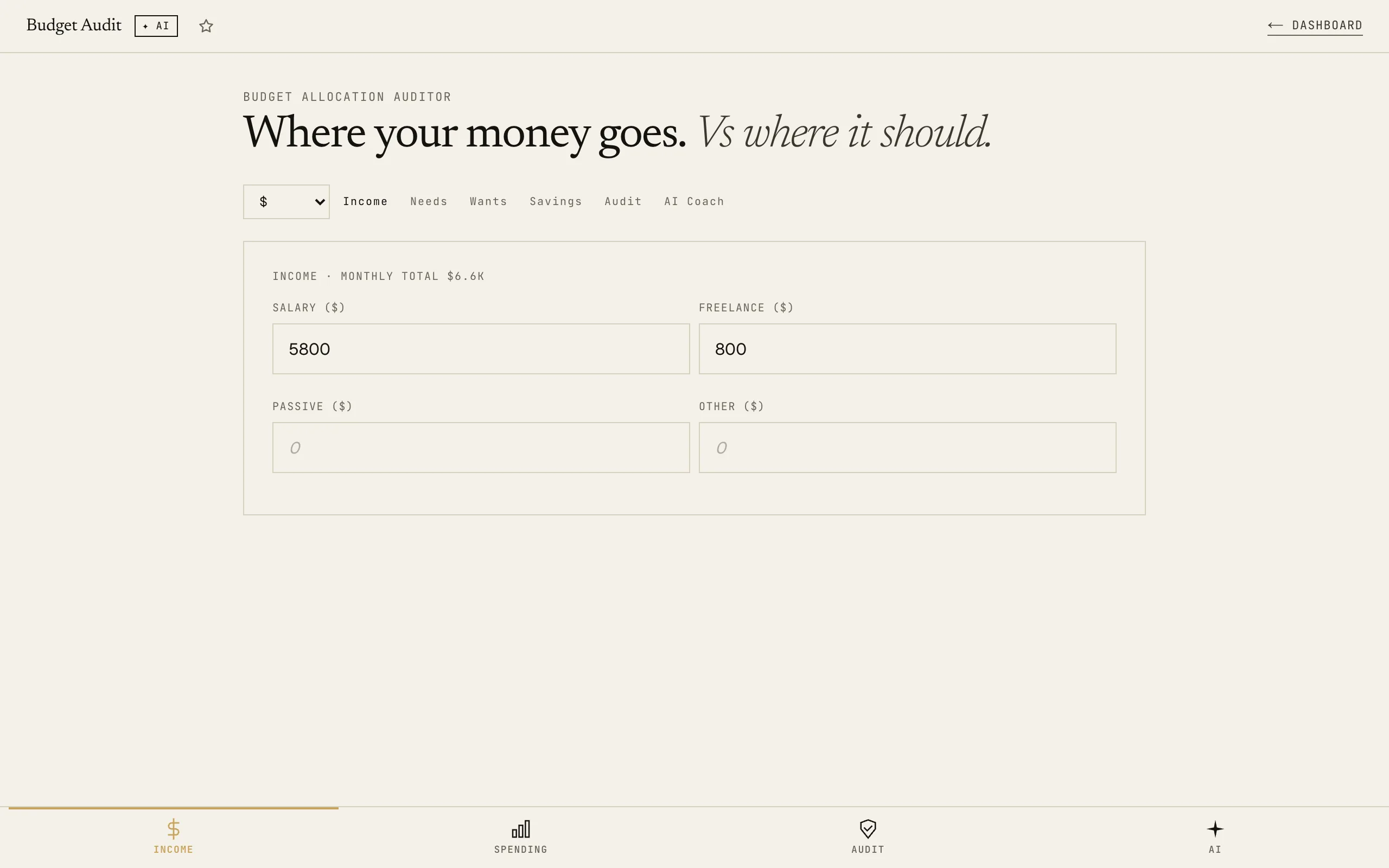
Drop in your income.
See exactly where your money goes.
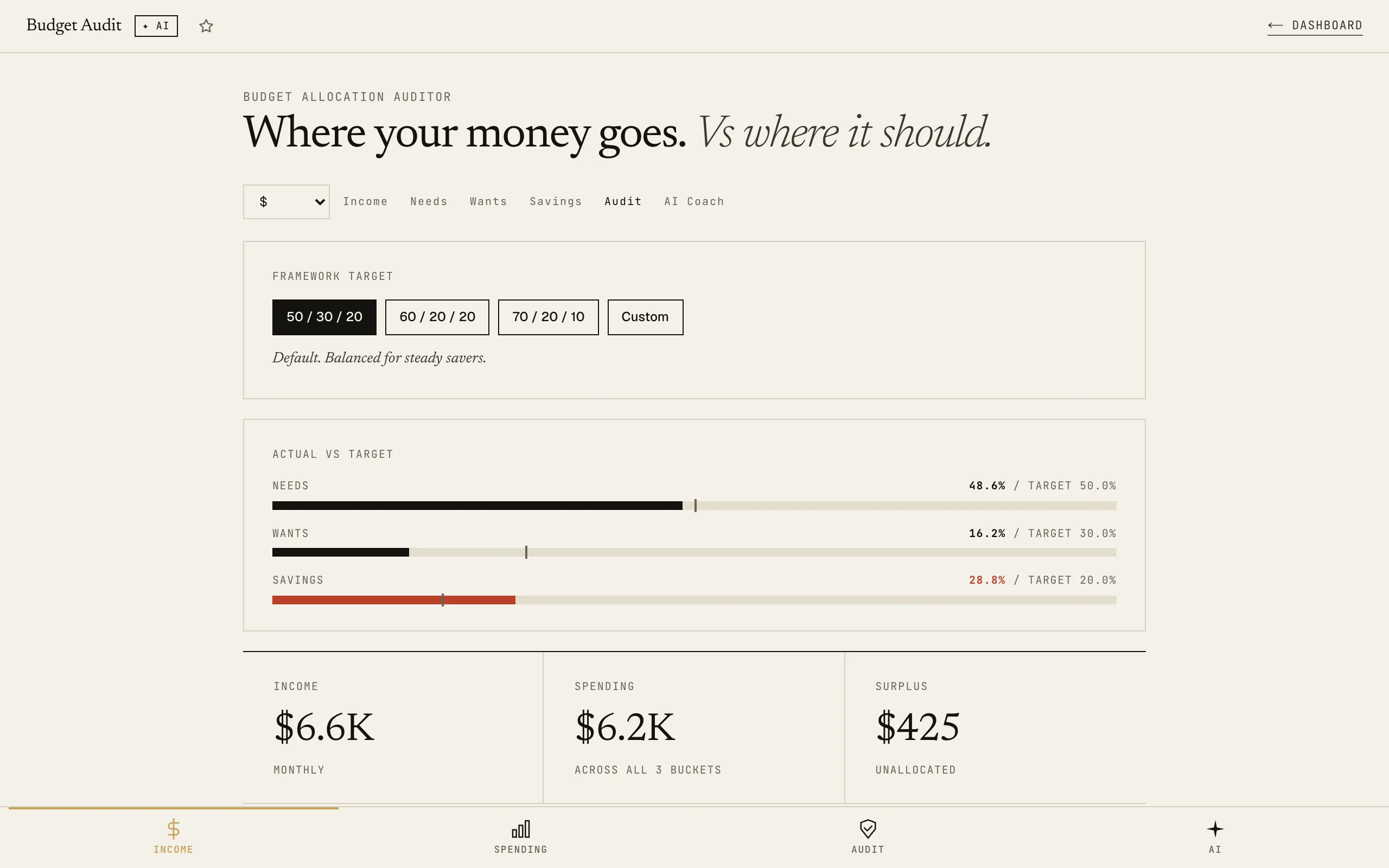
The 50/30/20 split, applied to your real numbers.
How it works
01Enter your monthly income
Salary, freelance, passive, other. The total becomes the denominator: every spending percentage is calculated against it.
02Enter every spending category
Six needs (housing, utilities, groceries, transport, insurance, debt), six wants (dining, entertainment, subscriptions, shopping, personal, hobbies), four savings categories. Every number updates the audit in real time.
03Read your audit and get your brief
Choose your framework: 50/30/20, 60/20/20, 70/20/10, or custom. See your alignment score, bucket deviation, surplus, and top spending list. Hit AI Coach for a four-section brief pinpointing your biggest lever.
You're wrong about where your money goes by 20–30%. A 5-minute audit finds the culprit.
Related tools · these read this one, and this one reads them
06 · FIN
Net Worth + FIRE Planner
Know your number, when you hit it, what changes if you save more, when you can coast, and whether debt comes first. 4 AI actions, one snapshot.
Open →Try it yourself · no signup, just play
Use Budget Allocation Auditor right here. No signup, no card.
Like it? Save your work and get the AI Coach.
Sign up freeFrequently asked
Which framework should I use?
50/30/20 is the standard: 50% needs, 30% wants, 20% savings. It works well for average cost-of-living areas and mid-range incomes. 60/20/20 suits high-cost cities like London, Singapore, or Sydney where housing costs push needs up. 70/20/10 is for periods of constrained income or heavy debt repayment. Custom lets you set your own targets if your situation doesn't fit a preset.
Should debt payments go under Needs?
Minimum debt payments go under Needs: they're non-negotiable obligations. Extra payments above the minimum are a financial choice (similar to savings), but for simplicity the auditor treats all debt payments as Needs. If your debt payments are very high, this pushes your Needs percentage up, which is the audit surfacing a real problem worth addressing.
What if my income varies month to month?
Use your average monthly take-home over the last 3 months. For freelancers or commission-based earners, a conservative average (e.g. your median, not your best month) gives you a more realistic baseline. You can re-run the audit with different income figures to see the sensitivity.
What does the alignment score actually mean?
It measures the total percentage-point deviation between your actual allocation and your framework target across all three buckets. A score of 100 means perfect alignment. Each percentage point of deviation reduces the score by 1.5 points. An 80+ score is solid; below 60 means at least one bucket is significantly off and the AI brief will identify it specifically.
What's the "surplus" in the audit?
The surplus is your income minus everything you've entered across all spending categories. If it's positive, that money isn't currently assigned to any category in your audit: it might be going somewhere you haven't logged, or it's genuinely unspent. If it's negative, you're spending more than you've entered as income, which flags a data entry issue or actual overspend.
Will my data be saved if I close the browser?
Yes: your income, spending, and framework preference save automatically to your browser's localStorage. Everything is there when you come back. Blacknave subscribers get cross-device sync so your budget audit carries across devices.