06 · FINLive✦ AI
Know exactly when you can stop working.
Track every asset and liability. Calculate your FIRE number. Then ask AI: full brief, what changes if I save $X more, when can I coast and stop saving, should I prioritise debt or investing. Every answer uses your real snapshot.
Financial brief · What-if save more · Coast FIRE check · Debt vs invest
Free · Every tool unlocked · No card
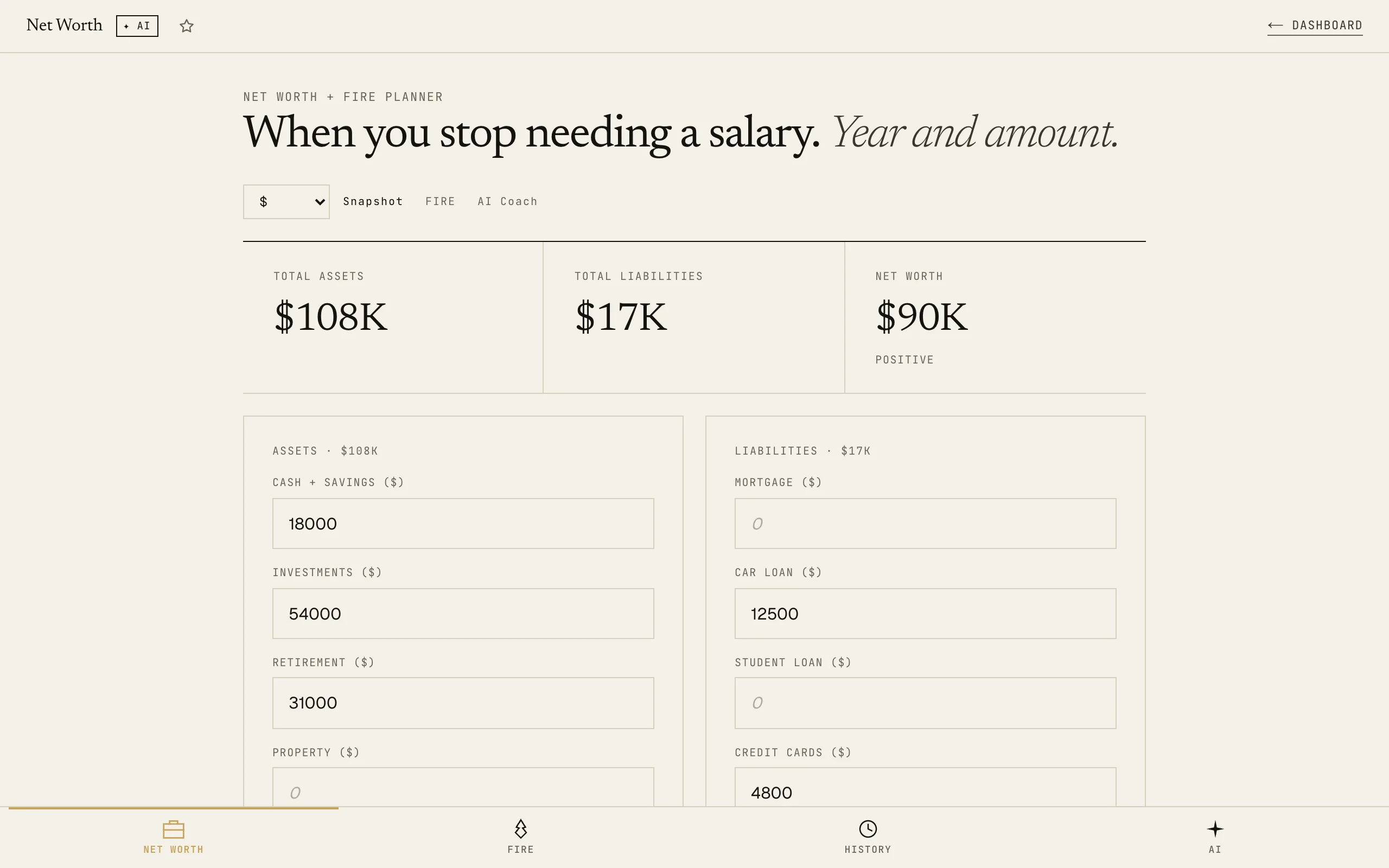
Every asset, every liability, one number.
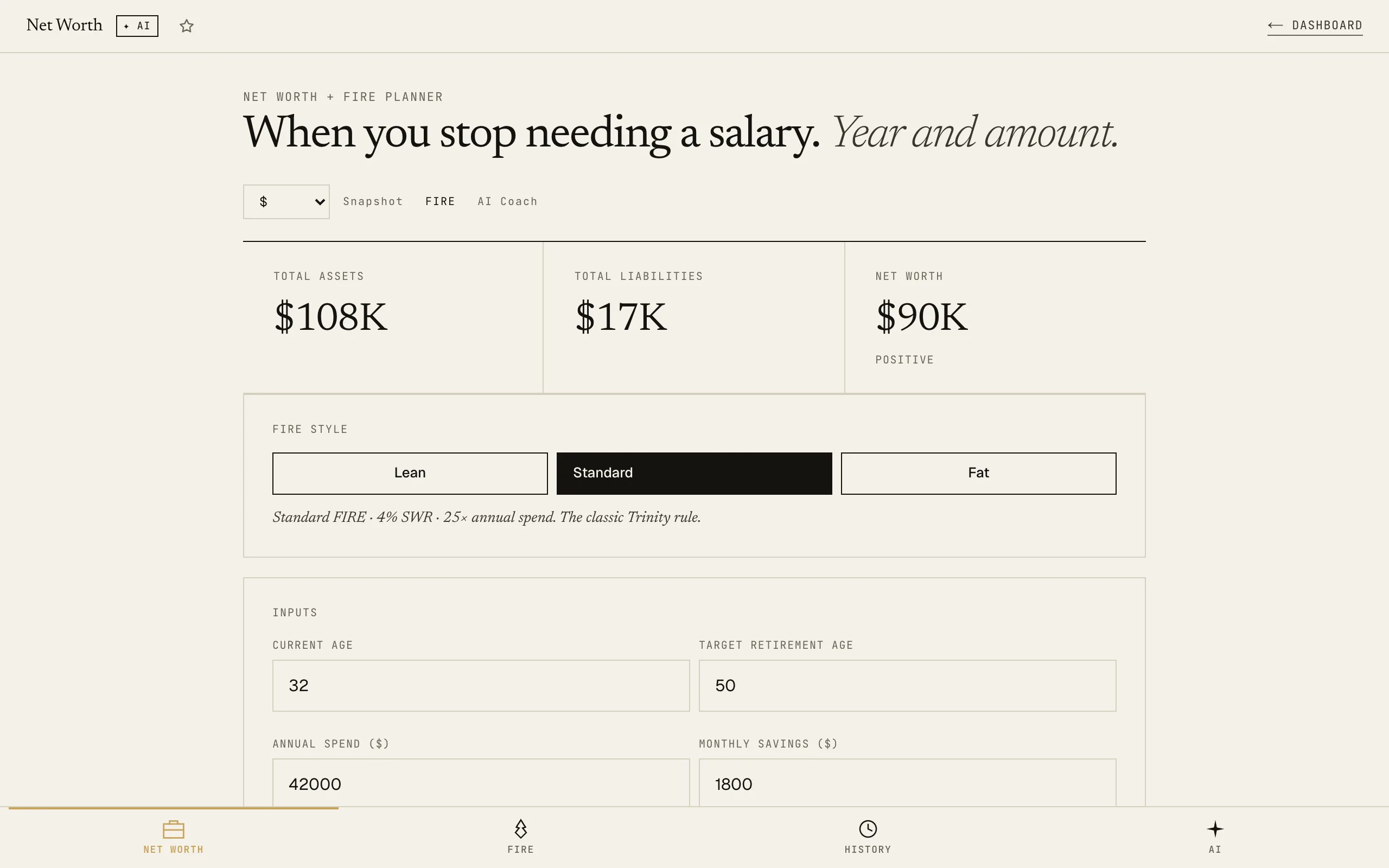
Your FIRE number and exactly when you hit it.
Plug in target, savings rate, expected return · get the year.
How it works
01Enter your assets and liabilities
Cash, investments, retirement accounts, property, other assets. Then mortgage, loans, credit cards. Your net worth calculates instantly.
02Set your FIRE profile
Current age, target age, annual spending, monthly savings, and your FIRE style: Lean, Standard, or Fat. The planner runs real-return math to show your years to FIRE and Coast FIRE number.
03Track it over time and get your AI brief
Save a snapshot today, come back monthly to see the trend. When you want a clear-eyed summary, hit the AI brief button: four sections: where you stand, FIRE timeline, biggest lever, this month's action.
Know your net worth. Know when you can stop working. Know the lever that moves both.
Related tools · these read this one, and this one reads them
Try it yourself · no signup, just play
Use Net Worth + FIRE Planner right here. No signup, no card.
Like it? Save your work and get the AI Coach.
Sign up freeFrequently asked
What can the AI coach actually do?
Four named actions. (1) Financial brief: 4-section analysis (where you stand / FIRE timeline / biggest lever / this month's action). (2) What-if save more: shows your new FIRE age at +$250/$500/$1000 monthly savings and names where the extra realistically comes from. (3) Coast FIRE check: approximates the age you could stop contributing entirely and let compound finish the job by your target retirement age. (4) Debt vs invest: reads your debt balances + expected return rate and gives a verdict (kill the 22% credit card first, or invest because your mortgage is below your return rate). Every answer reads your actual asset/liability snapshot.
Which FIRE style should I choose?
Lean FIRE (×20, 5% SWR) suits a minimal lifestyle with low fixed costs. Standard FIRE (×25, 4% SWR) is the Trinity study benchmark: maintains your current spending indefinitely. Fat FIRE (×33, 3% SWR) builds in a significant buffer for lifestyle inflation, healthcare, or early retirement with decades of runway. Start with Standard and see how the number feels.
What should I enter as "investments"?
Any market-linked account you're not touching until financial independence: brokerage accounts, ETFs, individual stocks, crypto held as a long-term position. Not your emergency fund (that goes in Cash). Not your pension if you can't access it until a fixed age: you can enter it under Retirement Accounts separately.
What is Coast FIRE?
Coast FIRE is the amount you need in your portfolio right now so that, with no additional contributions, compound growth alone will grow it to your full FIRE number by your target retirement age. If your current portfolio equals or exceeds your Coast FIRE number, you could theoretically stop contributing and still reach FIRE on time.
Should I include my home in net worth?
Yes: include the market value under Property. Then include your outstanding mortgage under Liabilities. The difference (equity) flows through to net worth automatically. Note that your home isn't counted in the investable portfolio for FIRE calculations, since you can't draw it down at 4% per year. The FIRE planner uses cash + investments + retirement accounts as your portfolio.
What return rate and inflation rate should I use?
A globally diversified equity portfolio has historically returned 7–10% nominal annually. Subtract inflation (typically 2–3%) for a real return of 4–7%. The default settings (7% return, 3% inflation) are conservative but realistic for a long-term equity portfolio. If you hold significant bonds or cash, lower the return rate.
Will my data be saved if I close the browser?
Yes: all assets, liabilities, FIRE settings, and history snapshots save automatically to your browser's localStorage. Blacknave subscribers get cross-device sync so your financial data follows you across devices.