10 · FINLive✦ AI
Stop arguing about whether to buy.
Enter both scenarios and see your break-even year, buyer equity versus renter investments, and a year-by-year wealth chart.
30-year simulation with a clear verdict on which one builds more wealth.
Free · Every tool unlocked · No card
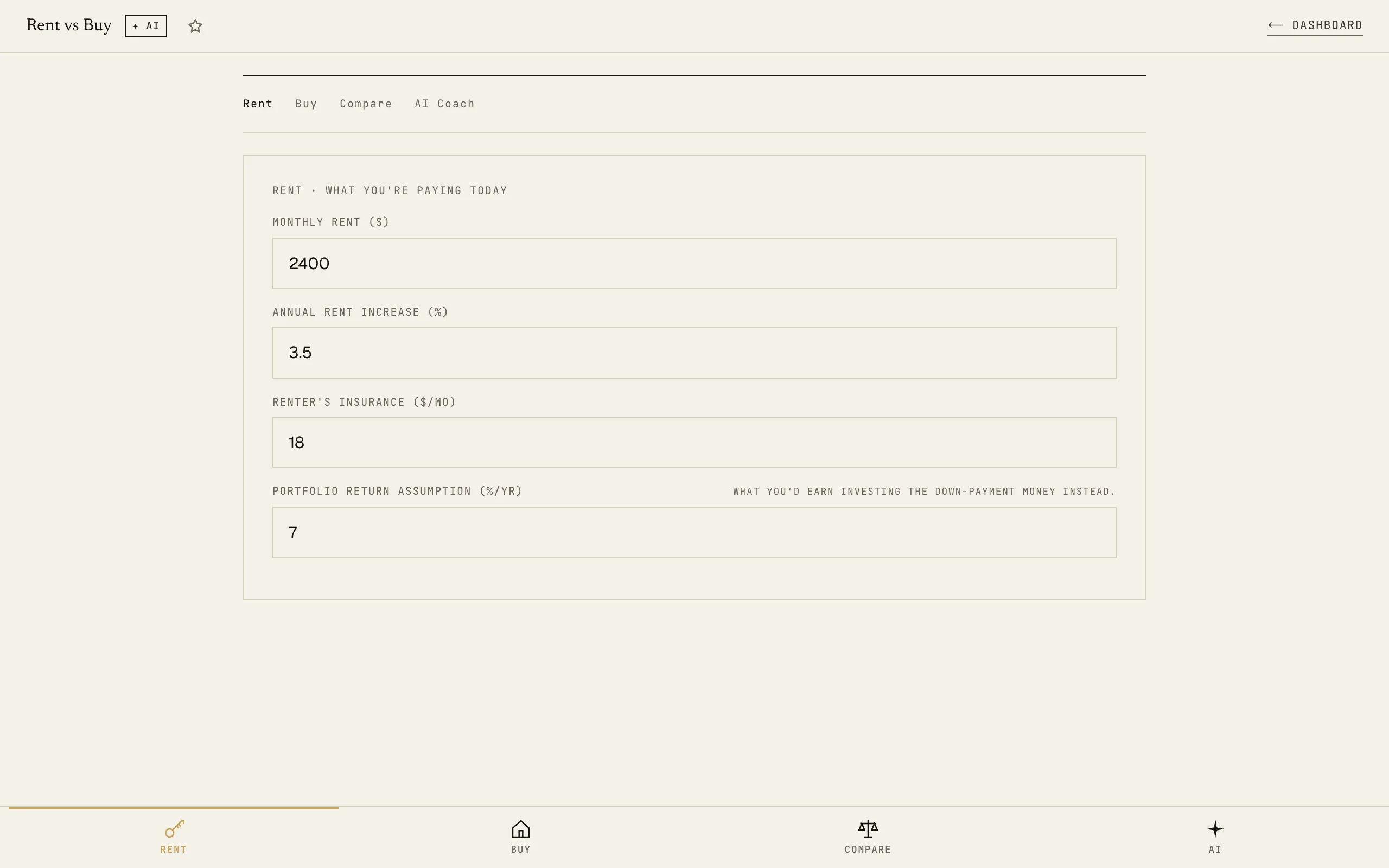
Drop in your rent and growth rate.
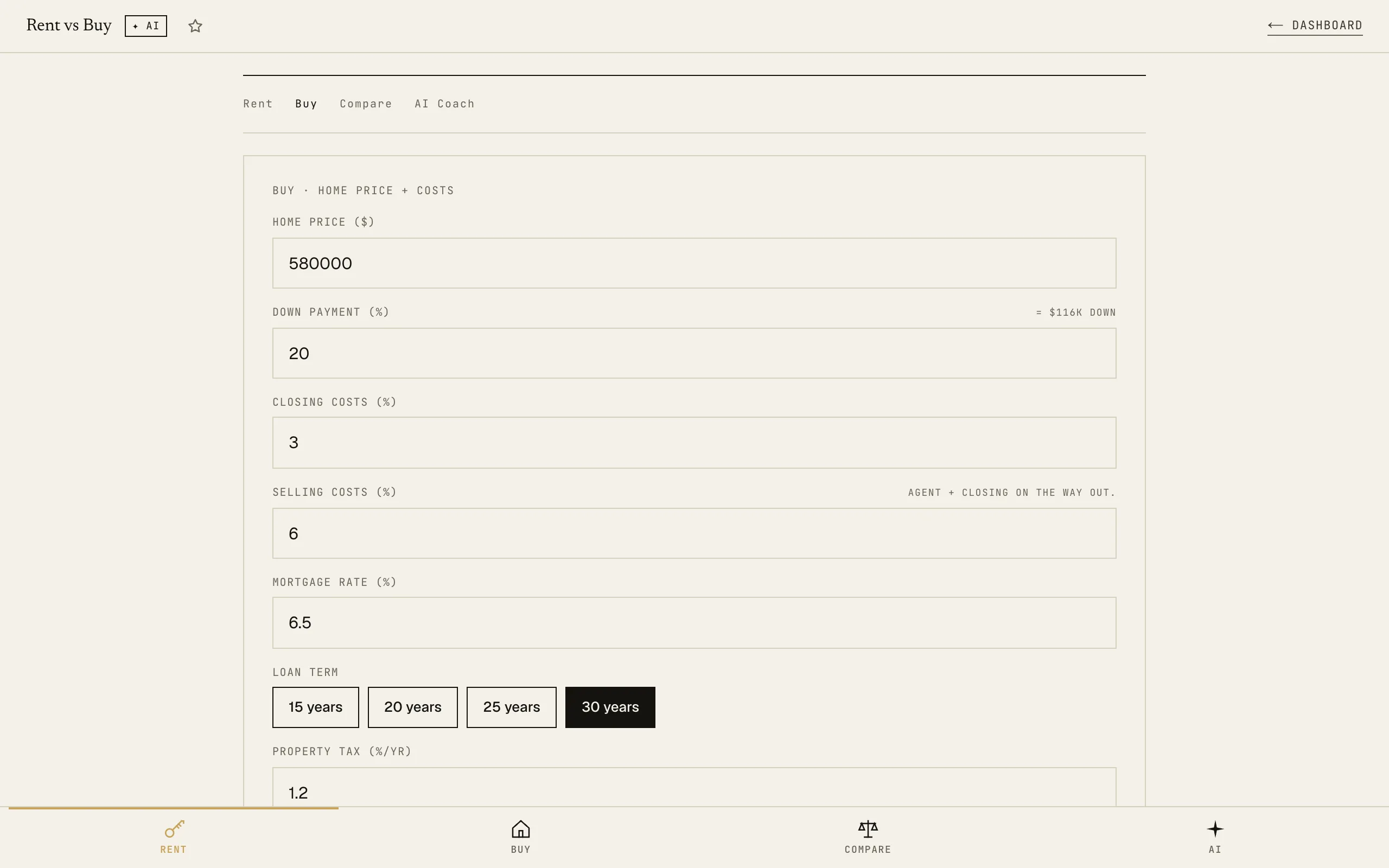
Price, down, rate, term.
How it works
01Enter your renting scenario
Monthly rent, expected annual rent increases, renter's insurance, and the investment return you'd earn on the down payment if you kept renting.
02Enter your buying scenario
Home price, down payment %, mortgage rate and term, property tax, insurance, HOA, maintenance rate, appreciation rate, and selling costs.
03Set your time horizon and read the comparison
Drag the slider for how long you'd stay. See the break-even year, wealth comparison at your horizon, year-by-year chart, and an AI brief that names the winning path and the one assumption that could flip the result.
Everyone has an opinion on whether you should rent or buy. Almost nobody has run the actual numbers for your situation. This does it in under 2 minutes.
Related tools · these read this one, and this one reads them
06 · FIN
Net Worth + FIRE Planner
Know your number, when you hit it, what changes if you save more, when you can coast, and whether debt comes first. 4 AI actions, one snapshot.
Open →Try it yourself · no signup, just play
Use Rent vs Buy Calculator right here. No signup, no card.
Like it? Save your work and get the AI Coach.
Sign up freeFrequently asked
Is the simulation realistic?
It models the major financial variables: full mortgage amortization, property appreciation, compounding investment returns, escalating rent, and selling costs. What it doesn't model: tax benefits of mortgage interest deduction (US), stamp duty tiers, capital gains tax on home sale, or behavioural factors (people don't always invest the savings). For a high-stakes decision, use this as a directional tool and verify with a financial advisor.
What investment return should I use?
The investment return is what you'd earn on the down payment (and monthly savings) if you rented and invested instead. A globally diversified equity index has historically returned 7–9% annually before inflation. Use 5–6% for a conservative estimate, 7% for historical average, 8–9% for optimistic. The sensitivity here is high: running the comparison at 5% vs 9% often flips the winner.
Why does the buyer start with negative wealth?
On day one, the buyer has spent the down payment and closing costs. Their equity is: home value minus mortgage balance minus selling costs minus closing costs already paid. Because selling costs are typically 5–6% of home value, and closing costs are 2–4%, the buyer starts "in the hole" and needs appreciation and principal repayment to climb out. This is why the break-even point is rarely at year 1.
How do selling costs affect the comparison?
Selling costs (typically 5–6% in Western markets from agent fees alone) are a major reason renting wins in short time horizons. On a 500K home, that's 25–30K off your equity every time you sell. The calculator includes selling costs in the buyer's net wealth calculation by default, which is the honest comparison.
What's a typical break-even point?
In most markets with 20% down, 7% mortgage rate, 1.2% property tax, and reasonable appreciation: the break-even is 7–12 years. In high-appreciation markets with low mortgage rates: 4–6 years. In high-cost cities with modest appreciation: 12–20 years or never within a 30-year horizon. Your break-even depends heavily on price-to-rent ratio, appreciation rate, and what you'd earn investing instead.
Will my data be saved if I close the browser?
Yes: all inputs and your time horizon save automatically to your browser's localStorage. Blacknave subscribers get cross-device sync so your comparison carries across devices.